Addresse
58 bis, avenue de Verdun
78290 Croissy sur Seine
Horaires de l'atelier
Du Mardi au Samedi
de 10h à 20h
le Dimance sur rendez_vous
Addresse
58 bis, avenue de Verdun
78290 Croissy sur Seine
Horaires de l'atelier
Du Mardi au Samedi
de 10h à 20h
le Dimance sur rendez_vous
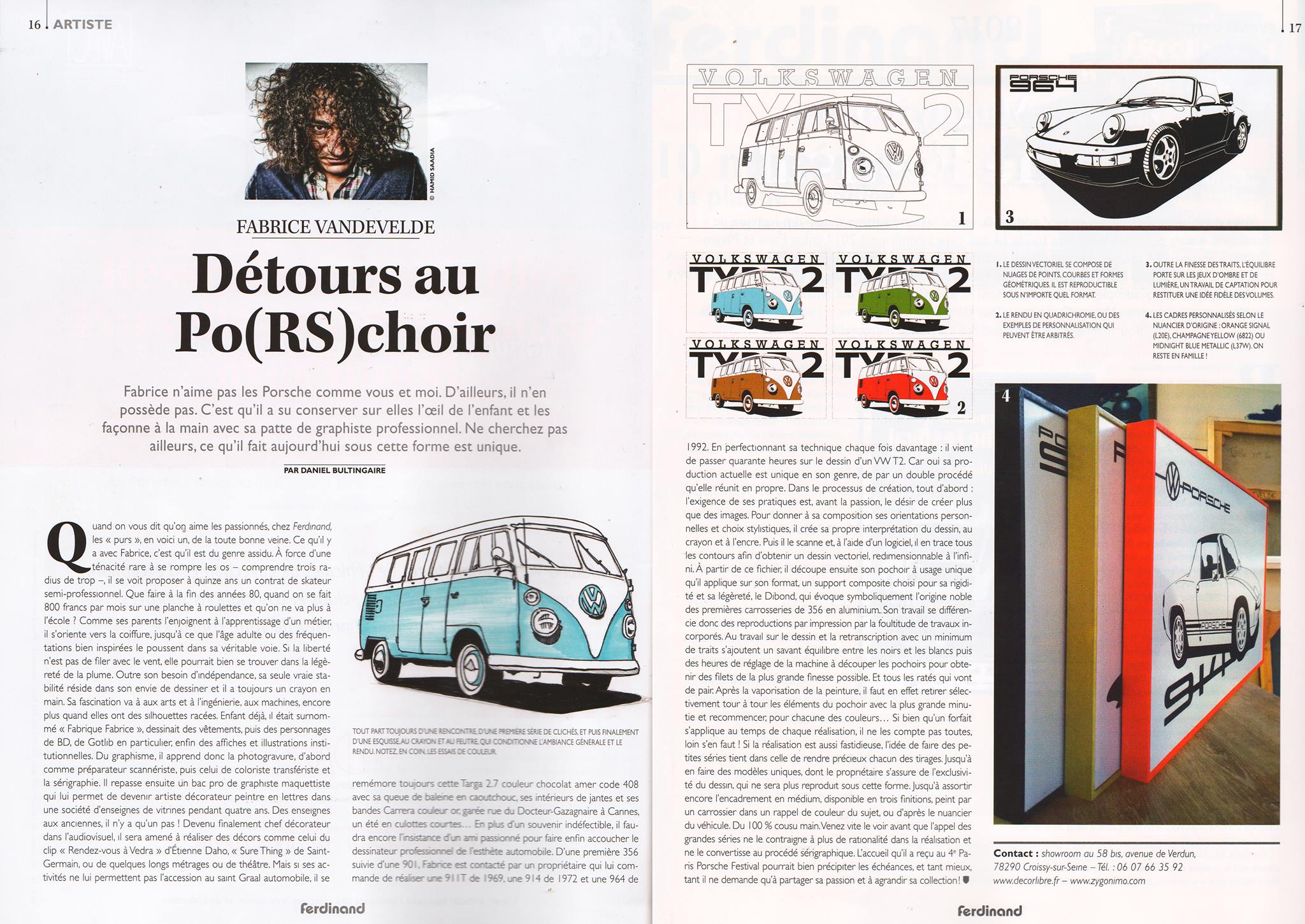
Fabrice doesn’t like Porsches like you and me. Besides, he doesn’t own any. It is that he was able to keep the child’s eye on them and shape them by hand with his paw as a professional graphic designer. Do not look elsewhere, what it does today in this form is unique.
When you say that we like enthusiasts, at Ferdinand, the “pure”, here is one, of the very good vein. What there is with Fabrice, it’s that he is the diligent type. Through a rare tenacity to break his bones — understand three radius too many—, he is offered at fifteen a contract as a semi-professional skater. What to do at the end of the 80s, when you earn 800 francs per month on a skateboard and no longer go to school? As his parents enjoin him to learn a trade, he turns towards hairdressing, until adulthood or well-inspired associations push him into his true path. If freedom is not to drift with the wind, it could well be in the lightness of the feather. Besides his need for independence, his only true stability lies in his desire to draw and he always has a pencil in hand. His fascination goes to arts and engineering, to machines, even more so when they have racy silhouettes. As a child, he was nicknamed ‘Fabrice Ferrari’ drawing cars, then comic characters, especially Gotlib, and finally institutional posters and illustrations. From graphics, he therefore learns photoengraving, first as a scanner preparer,then that of transferist colorist and the screen printing. He then passes again a vocational baccalaureate in graphic design, which allows him to become a decorative artist and painter in letters in a company of shop signs for four years. From signs to old ones, there is only one step! Finally become a production designer in the audiovisual sector, he will have to create sets such as that of the clip ‘Art de rue/Fonky Family’ by Sure Thing of Saint-Germain, or some feature films or theatre. But if his activities do not allow him access to the holy automobile grail, he always turns from an encounter of a first series of shots and then finally from a pencil and marker sketch which conditions the general atmosphere and the rendering. Note, in corner, the color tests.
Everything always starts from an encounter, a first series of shots and then finally from a sketch in pencil and marker that conditions the general atmosphere and the rendering. Note, in corner, the color tests.
Always thanking this Targa 2.7 bitter chocolate code 408 with its rubber whale tail, its rims interior and its stripes Carrera color or parked rue du Docteur-Gazagnaire in Cannes, a summer in short flip flops… In addition to an indefectible memory, it will be necessary to insist with a passionate soul to finally bring the professional draftsman of the automotive esthete to fruition. From a first 356 followed by a 901, Fabrice is contacted by an owner who orders him to build a 1969 911T, a 1972 914 and a 1992 964. Perfecting his technique each time more: he has just spent forty hours on the drawing of a VW T2.Because yes, its current production is unique in its kind, by a double process that it brings together on its own. In the creative process, first of all: the requirement of its practices is, before passion, the desire to create more than images. To give his composition its personal orientations and stylistic choices, he creates his own interpretation of the drawing, in pencil and ink. Then he scans it and, using a software, traces all the contours in order to obtain a vector drawing, infinitely resizable.From this file, he then cuts his single-use stencil which he applies to its format, a composite support chosen for its lightness and lightness. The Dibond, which symbolically evokes the noble origin of the first aluminum 356 bodies. His work is therefore differentiated from print reproductions by the pride of incorporated works. At work on the drawing and transcription with a minimum of strokes, a skillful balance between blacks and whites is skipped, followed by hours of adjustment of the stencil cutting machine to obtain the fillets of the greatest possible finesse. And it’s a failure if you don’t see the spraying of the paint,it is indeed necessary to selectively remove in turn the elements of the stencil with the greatest care and start again, for each shade of color… So well that a format applies to the time of each achievement, it does not count them all, far from it! If the production is so tedious, the idea of making small series still lies in making each print valuable. To the point of making unique models, whose owner ensures the exclusivity of the drawing, which will no longer be reproduced in this form, until still matching the frame in medium, available in three finishes, painted by a coachbuilder in a quick stroke of color of the subject, or after the vehicle’s color chart. 100% hand-sewn. Come and see it quickly before the call of large series forces him to more rationality in production and converts him to the serigraphic process. The welcome he received at the 4th Paris Porsche Festival could well precipitate exchanges, and so much the better, as he only asks to share his passion and expand his collection!